
If you have ever caught your reflection from the side and wondered what a slightly different bridge or tip would do for your whole face, you are not imagining things that do not matter. The nose sits at the center of every expression, every photo angle, every first impression.
Rhinoplasty in Miami is one of the most requested facial procedures in the country, and for good reason: a change of a few millimeters can shift how balanced an entire face reads. In 2025, the United States saw roughly 1.4 million surgical rhinoplasties, keeping the procedure among the top three facial surgeries alongside facelifts and blepharoplasties. That volume tells you this is a mainstream, well-understood procedure, not an experimental one.
This guide walks through what rhinoplasty actually is, the different surgical approaches available, how to know if you are a good candidate, what recovery really looks like week by week, and the specific criteria that separate a qualified surgeon from a risky one.
What is rhinoplasty?
Rhinoplasty is a surgical procedure that reshapes the bone and cartilage of the nose to change its size, shape, or function. It can be performed for aesthetic reasons, to correct breathing problems caused by structural issues like a deviated septum, or both at once.
Rhinoplasty is not a quick, one-size-fits-all fix, or a procedure that produces its final result in a matter of weeks. Swelling resolves gradually, and most surgeons consider the one-year mark the point at which the nose has truly settled into its final shape.
There are two broad reasons patients pursue this procedure in Miami. Some want to refine a feature they have felt self-conscious about for years, often a dorsal hump, a wide tip, or asymmetry from a previous injury. Others come in specifically for functional concerns, like chronic nasal congestion tied to a deviated septum.
Rhinoplasty, alongside facelifts and blepharoplasty, has remained among the top three facial surgical procedures for the past five years, and it continues to be the most requested of the three. A procedure performed this often, by this many specialists, has a well-documented safety and technique profile, which is part of why patients tend to feel more confident moving forward once they understand it.
Types of rhinoplasty
Not every nose surgery is built the same way. The right approach depends on what you want to change, how much correction is needed, and whether you have had previous nasal surgery.
Here is how the main types compare.
| Type | Incision approach | Best suited for | Typical recovery |
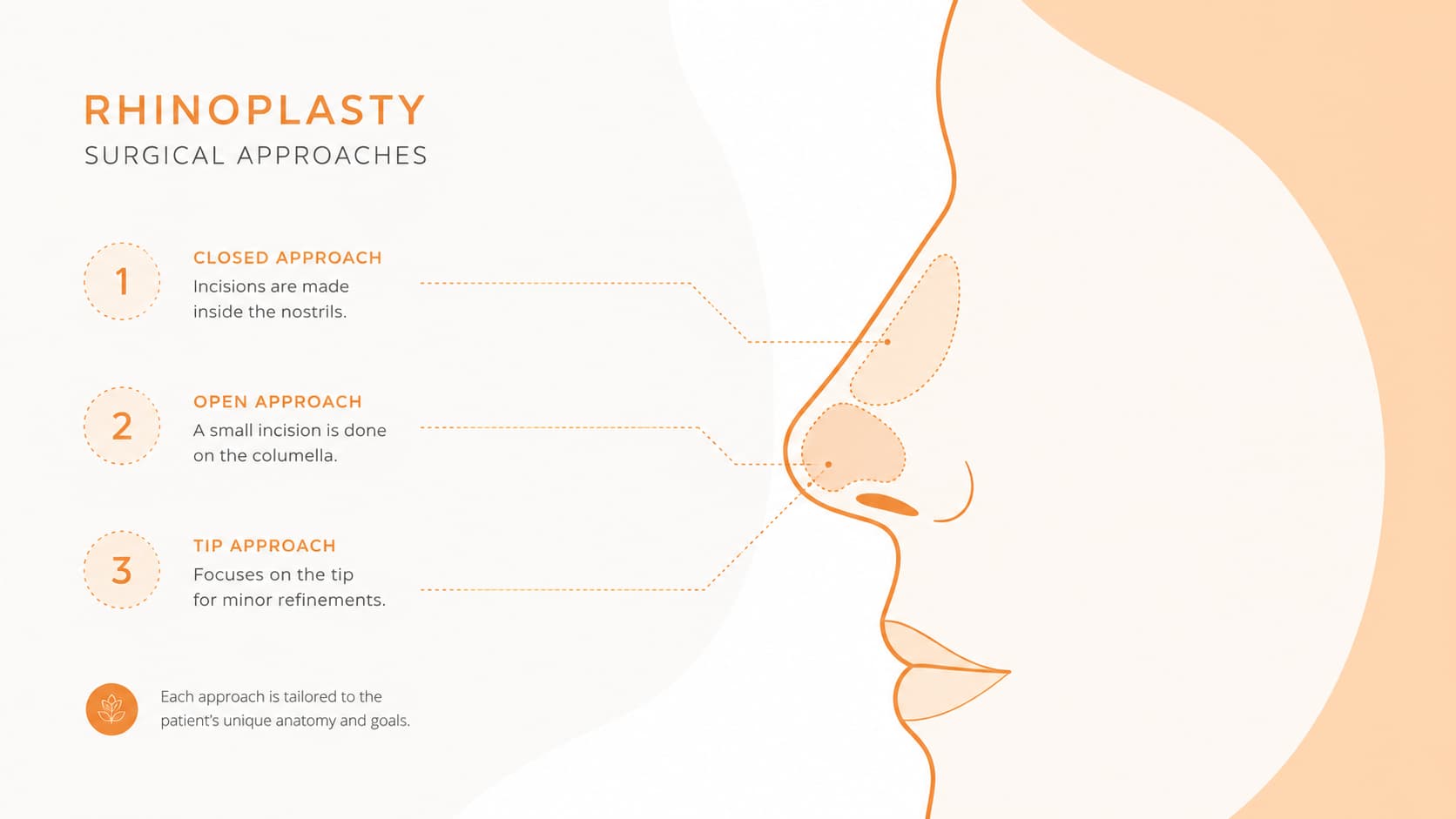
| Closed rhinoplasty | All incisions hidden inside the nostrils | Minor to moderate reshaping, no visible scarring | Often slightly faster initial healing |
| Open rhinoplasty | Small incision across the columella (the strip of tissue between nostrils) | Complex reshaping requiring full visibility of the nasal structure | Comparable long-term healing, more precise access |
| Ethnic rhinoplasty | Closed or open, depending on the case | Patients seeking refinement while preserving features tied to their heritage | Tailored to the specific structural goals |
| Functional rhinoplasty | Closed or open, focused on the septum and internal passages | Patients with breathing difficulty from a deviated septum or structural collapse | Recovery similar to cosmetic rhinoplasty, sometimes combined with it |
| Revision rhinoplasty | Typically open, due to scar tissue from a prior surgery | Correcting results from a previous rhinoplasty | Longer and more complex than a primary procedure |
Ethnic rhinoplasty deserves its own mention here, particularly for Miami’s diverse patient population. This approach is not a separate surgical technique so much as a different way of thinking about the goal: rather than applying one universal aesthetic standard, the surgeon works to refine the nose while keeping its proportions consistent with the patient’s facial heritage and ethnic background. For a city where the majority of patients are of Hispanic or Latin American descent, this distinction often matters as much as the technique itself.
Revision cases also deserve attention before you choose a surgeon. Roughly 80 percent of facial plastic surgeons report that more than 10 percent of their rhinoplasty patients are seeking revisions of a previous surgery. That figure underscores something worth taking seriously: getting it right the first time, with a surgeon experienced in your specific case type, tends to be far simpler than correcting it later
Am I a candidate? Signs you should consider a nose job in Miami
Before booking a consultation, it helps to run through a short self-check. You are likely a reasonable candidate for rhinoplasty in Miami if most of the following apply to you:
- You are unhappy with a specific feature of your nose (bridge, tip, width, or symmetry) rather than your appearance in general.
- You experience breathing difficulty that a doctor has linked to nasal structure, such as a deviated septum.
- Your facial growth is complete, generally from around age 16 onward.
- You are in overall good health, with no uncontrolled conditions that would raise surgical risk.
- You have realistic expectations about what surgery can change and how long it takes to see final results.
- You do not smoke, or you are willing to stop well before and after surgery, since smoking impairs healing.
If you checked most of these boxes, the next reasonable step is a consultation rather than more research. A surgeon needs to examine your nasal structure directly, which photos and online quizzes cannot replace.
What to expect: from consultation to full recovery
Understanding the full arc of the process, not just the surgery date, makes the decision feel far less abstract.
- Schedule a consultation: Your surgeon evaluates your nasal anatomy, breathing function, skin thickness, and goals before explaining which approach fits your case, since skin thickness alone changes how long swelling takes to resolve and shapes your entire recovery timeline.
- Confirm your surgical plan and anesthesia type? Rhinoplasty can be performed under local anesthesia with sedation or general anesthesia, depending on complexity, so knowing this in advance lets you plan time off work and arrange a ride home.
- Undergo the procedure: The surgeon reshapes bone and cartilage through the chosen incision approach and corrects the septum if a functional issue is present, which means combining cosmetic and functional correction in one surgery avoids a second procedure later.
- Begin the splint and rest period: A nasal splint protects the new structure for about a week, and skipping rest during these first days is the most common reason early swelling lingers longer than expected.
- Resume light activity gradually: Most patients return to desk work within one to two weeks, while strenuous activity stays off-limits a bit longer, since returning to it too early raises the risk of trauma to a nose that has not yet stabilized.
Here is how recovery typically unfolds over time:
| Recovery stage | What to expect |
| Week 1 | Splint and possible internal packing, swelling, bruising around the eyes, rest is the priority |
| Weeks 2-4 | Visible bruising fades, light activities resume, sports and contact still off-limits |
| Months 1-3 | Initial shape becomes visible, mild swelling can persist near the tip |
| Months 6-12 | Final shape fully visible, internal and external healing essentially complete |
Results vary by patient, and thicker skin generally takes longer to reveal the final tip definition. Most patients see the final shape stabilize by twelve months, with swelling typically subsiding within three to four months, though some edema can linger up to six months. Patience during this window is not a sign that something went wrong. It is simply how nasal tissue heals.
Patient satisfaction with this timeline is consistently high across age groups. The American Society of Plastic Surgeons reports a 96% satisfaction rate among rhinoplasty patients, with comparable results across teens, adults aged 20 to 34, 35 to 54, and those over 55.
How to choose the right rhinoplasty surgeon in Miami?
Miami has one of the highest concentrations of facial plastic surgeons in the country, which means choice is not the problem. Verification is.
Use this checklist before booking any consultation:
- Confirm board certification: Look specifically for certification by the American Board of Plastic Surgery (ABPS) or, for facial-focused practices, the American Board of Facial Plastic and Reconstructive Surgery. Either credential confirms standardized training and examination.
- Ask how much of their practice is dedicated to rhinoplasty specifically: A surgeon who performs this procedure regularly, not occasionally, tends to have more refined judgment on difficult cases.
- Review healed results, not just immediate post-op photos: Ask to see outcomes at the one-year mark, since that is when swelling has fully resolved.
- Confirm the surgical facility’s accreditation: An accredited facility means independently verified safety standards for anesthesia and surgical care.
- Evaluate communication during the consultation:A surgeon who answers questions about your specific anatomy, rather than giving generic reassurances, is a stronger sign of individualized planning than any marketing claim.
- Ask directly about revision rates and how complications are handled: A surgeon who answers this plainly is being transparent with you.
Price should be one of the last factors you weigh, not the first. The American Society of Plastic Surgeons reports that the average rhinoplasty cost nationally is $7,637, with Miami prices typically ranging from $5,000 to $20,000 depending on procedure complexity and surgeon experience.
A lower price does not guarantee savings if it leads to a revision, and a higher price alone does not guarantee a better outcome either. Credentials and consistency matter more than either extreme.
Read more:
👉 How much does a nose job cost?
Why patients in Miami choose Smart Plastic Surgery for rhinoplasty
Once you know what to look for in a surgeon, it becomes much easier to see why Smart Plastic Surgery stands out among Miami’s rhinoplasty providers.
Our team of board-certified plastic surgeons includes Dr. Joel Shanklin, Dr. Jeffrey Weinzweig, Dr. John Pitman III, Dr. Richard T. Vagley, and Dr. Zachary Okhah, each trained to the certification standard set by the American Board of Plastic Surgery. That credential matters because it confirms standardized residency training and rigorous examination, not just years of marketing.
Three things set our approach apart for rhinoplasty specifically:
- A full range of approaches under one roof: Because our rhinoplasty program covers cosmetic, functional, ethnic, and revision cases, your surgeon designs a plan around your specific anatomy and goals rather than fitting you into a single technique the practice happens to specialize in.
- Trilingual care that removes a real barrier: Miami’s patient population is largely Hispanic, and a consultation conducted entirely in your native language, English, Spanish, or Portuguese, changes how clearly you can communicate concerns about your own face. Our team provides care in all three.
- Transparent, accessible financing: Through Affirm and Alphaeon, patients can plan the financial side of rhinoplasty with the same clarity they expect from the surgical plan itself, without the cost being the deciding factor in choosing a less experienced surgeon.
If you have read through the candidacy checklist above and recognized yourself in it, the next step is a conversation with a surgeon who can examine your nasal anatomy directly.
Schedule a consultation with Smart Plastic Surgery to find out which approach fits your face, not someone else’s.