
If you’ve been researching body contouring, you’ve probably run into two completely different stories: some sources say liposuction results last forever, others warn that the fat just comes back eventually. Both versions sound convincing, and that’s exactly why the confusion sticks around.
Liposuction permanently removes fat cells from the treated area, and those specific cells cannot regenerate. That part is biological fact, not marketing language. What it does not mean is that your results are frozen in time forever, immune to weight changes, aging, or lifestyle. Permanence and predictability are two different things, and understanding that distinction is what actually helps you plan for lasting results.
This guide breaks down the science behind fat cell removal, what can realistically change your results over time, and how board-certified surgeons in Miami help patients protect their investment for years to come.
Is liposuction permanent?
Yes. Liposuction permanently eliminates fat cells from the specific areas treated during surgery, and the body does not grow new fat cells to replace them. This is a one-time biological change, not a temporary reduction like the kind you get from dieting.
What liposuction is not is a permanent guarantee that your body will never change again. The remaining fat cells in your body, both in treated and untreated areas, are still fully capable of expanding if you gain weight. Your surgeon removes a portion of the fat cells in a given area, not all of them, since some fat is necessary to protect muscle and skin.
The American Society of Plastic Surgeons notes that once fat cells are suctioned out during the procedure, they do not grow back, although the cells that remain in the treated area can still increase in size with significant weight gain.
This is the central nuance most patients miss: the cells are gone permanently, but the canvas they leave behind still responds to your lifestyle.
How liposuction removes fat cells for good
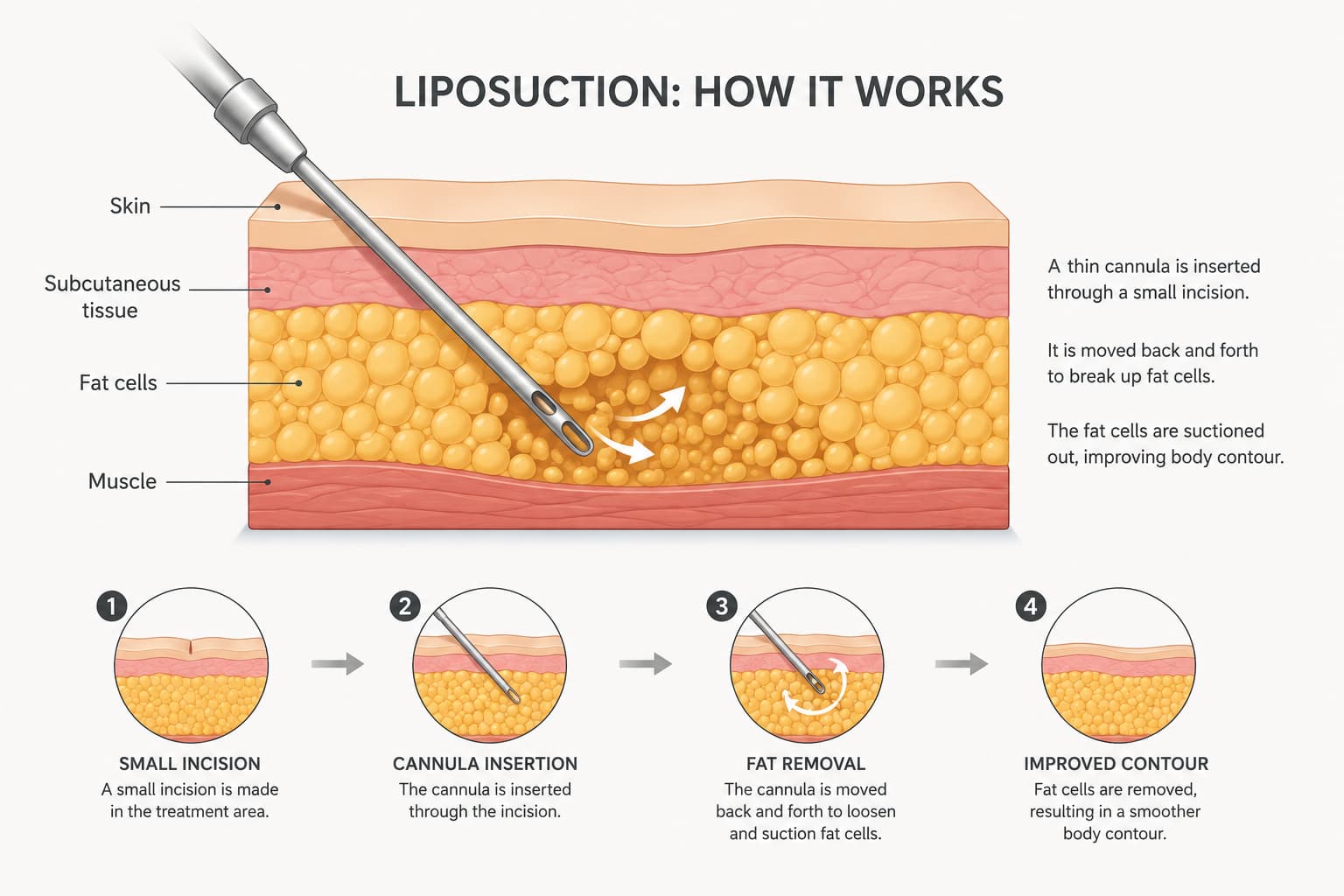
To understand why results hold up, it helps to know what actually happens during the procedure. A surgeon makes small incisions and inserts a thin tube called a cannula into the layer of fat sitting just beneath your skin. The cannula breaks up and suctions out fat cells (adipocytes) directly from your body.
This is fundamentally different from how fat behaves when you lose weight through diet and exercise. When you lose weight naturally, your fat cells don’t disappear, they shrink. They remain in your body, ready to expand again if your calorie intake increases. Liposuction removes the cells entirely, taking them out of the equation rather than just deflating them.
Scientific research has shown that the total number of fat cells in the human body is largely established by early adulthood, and adults do not typically generate new fat cells in areas where they’ve been surgically removed. That’s the biological reason liposuction is described as a permanent procedure rather than a temporary fix.
Read more:
👉 Recommended diet before and after plastic surgery
Liposuction vs. natural weight loss
Patients often assume liposuction is just a faster way to lose weight. It isn’t, and the comparison below shows why the mechanism, not just the speed, makes all the difference.
| Criteria | Liposuction | Natural weight loss |
| What happens to fat cells | Physically removed from the body | Shrink in size, but remain in the body |
| Can cells return or regrow | No, treated cells cannot regenerate | Yes, shrunk cells can expand again |
| Area affected | Targeted, localized areas | Whole-body, not localized |
| Best for | Stubborn pockets resistant to diet/exercise | Overall body weight reduction |
| Weight loss expected | Typically modest, a few pounds | Can be substantial depending on effort |
This is why liposuction is classified as a body contouring procedure rather than a weight-loss treatment. It refines shape in specific areas; it does not replace the broader work of maintaining a healthy weight.
What can change your results over time
Permanent fat cell removal is only one part of how your results look five or ten years down the road. A few real factors influence the bigger picture.
Weight fluctuations
If you gain a meaningful amount of weight after surgery, the fat cells that remain in your body, including in the treated area, can still expand.
Because the treated zone now has fewer fat cells than before, weight gain often shows up more in untreated areas first, which can create a slightly uneven appearance if the scale moves a lot.
Read more:
👉 What Happens When You Gain Weight After Liposuction?
Skin elasticity and aging
Liposuction sculpts fat, not skin. As skin naturally loses collagen and elastin with age, it becomes less able to “snap back” tightly over the new contour.
Patients in their twenties and thirties frequently see tighter results than patients having the procedure later in life, simply due to differences in skin quality, not the surgery itself.
Pregnancy and hormonal changes
For women, pregnancy after liposuction can stretch skin and shift fat distribution again, particularly around the abdomen. This isn’t a failure of the original procedure; it’s a separate physiological event layered on top of it.
⚠️ Attention: This information is educational and intended for adults evaluating liposuction as a body contouring option. It does not replace a medical evaluation. Every surgery carries risk, including infection, contour irregularities, and changes in skin sensation. Results vary by patient, and a board-certified plastic surgeon should assess your candidacy, skin quality, and goals before any procedure is scheduled.
Lipo 360 and advanced techniques: does the method affect permanence?
The fat-removal mechanism behind permanence is the same across liposuction techniques, but the technique chosen can affect how proportional and natural the long-term result looks.
Lipo 360, for example, treats the abdomen, flanks, and back simultaneously rather than one isolated zone, which can reduce the kind of disproportionate appearance that sometimes develops if only one area was treated and weight changes later affect the rest of the torso unevenly.
At Smart Plastic Surgery, our Lipo 360 approach is one of several options our surgeons evaluate during consultation, alongside traditional and VASER-assisted liposuction, depending on each patient’s anatomy and goals.
Why choose Smart Plastic Surgery for long-lasting results
The permanence of your results depends heavily on who performs the procedure, not just the procedure itself.
Liposuction performed by an experienced, board-certified plastic surgeon carries a documented complication rate as low as 1.5%, according to a study cited by the American Society of Plastic Surgeons, and that risk drops further when the surgery takes place in an accredited surgical facility.
At Smart Plastic Surgery in Miami, every liposuction procedure is performed by surgeons certified by the American Board of Plastic Surgery (ABPS), working in a registered, accredited facility, which is the same standard referenced in that ASPS data. Beyond the surgical credentials, our team consults with patients in English, Spanish, or Portuguese, so nothing about your candidacy, your technique options, or your recovery plan gets lost between languages.
We also walk patients through realistic timelines for when swelling resolves and final contours become visible, set expectations around skin elasticity and weight stability before surgery (not after), and offer financing options through Alphaeon Credit and CareCredit so the cost of a board-certified procedure doesn’t have to mean compromising on who performs it.
If you’re trying to figure out whether your fat distribution, skin quality, and goals make you a strong candidate for lasting results, a one-on-one evaluation is the only way to know for certain.
Schedule a consultation with our team to discuss your specific anatomy and which technique, traditional liposuction or Lipo 360, fits your goals.