
Have you ever looked at yourself in the mirror and wondered what it would be like if that part of your body that bothers you could be different? Maybe you’ve spent hours researching procedures online, saving before-and-after photos, only to stop at the same question every time: “Can I actually do this? Am I a good candidate for plastic surgery?”
This doubt is far more common than you might think. And the truth is, not everyone is ready for plastic surgery at this moment — and that’s completely okay.
Understanding whether you’re a good candidate isn’t about judgment. It’s about protecting your safety, your health, and your satisfaction with the results.
In this article, we’ll explore together the main criteria plastic surgeons consider when determining whether someone is ready to take this step.
Medical criteria that define a good candidate
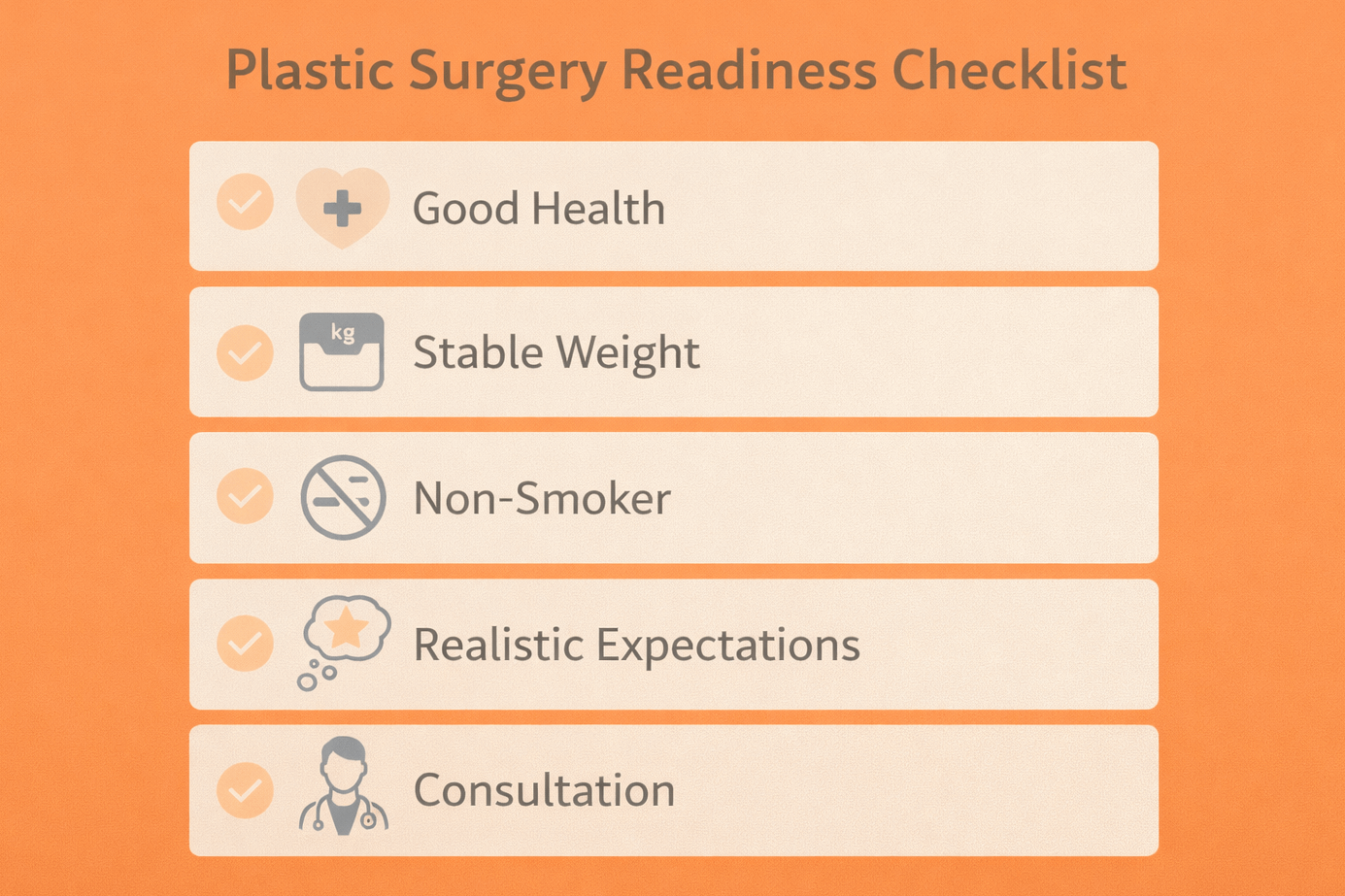
During the consultation, the surgeon evaluates a set of factors. These don’t work as a pass-or-fail checklist, but rather as a guide for making safe decisions.
Stable physical health
One of the main plastic surgery requirements is having stable physical health. This doesn’t mean you need to be perfectly healthy, but that any medical conditions are well managed.
Conditions such as uncontrolled diabetes, serious heart problems, or blood clotting disorders can increase surgical risks. On the other hand, if you have diabetes that is well controlled with medication and proper medical follow-up, you may still qualify as a healthy candidate for plastic surgery.
Your surgeon will request preoperative exams and may also ask for medical clearance from your primary physician. This step isn’t red tape — it’s protection. Think of it as a safety net to make sure your body is prepared for the procedure.
💡 Important tip: Be completely honest about your medical history during the consultation. Omitting information can put your life at risk.
Stable weight within a healthy range
Here’s a truth many people don’t like to hear: plastic surgery is not a weight-loss treatment. Procedures such as liposuction and tummy tuck are body contouring procedures, not methods for losing weight.
Most plastic surgeons recommend maintaining a stable weight for at least six months before surgery. Why? Because significant weight fluctuations after procedures like a tummy tuck or breast lift can compromise results entirely.
If you’re still in the process of losing weight, consider waiting until you reach your goal and can maintain it. Your future self will thank you when the results continue to look great for years.
Non-smoker or willing to stop
This is one of the strictest non-smoker plastic surgery requirements, and for good reason. Smoking significantly affects blood circulation and the body’s ability to heal.
Smoking increases the risk of skin necrosis, infections, poor scarring, and anesthesia-related complications. This isn’t exaggeration — it’s well-documented science.
The good news? Once you stop smoking, your body begins to recover. Most surgeons require patients to quit at least 4 to 6 weeks before surgery and remain smoke-free throughout the recovery period.
💡 Important tip: This includes e-cigarettes and vaping. Nicotine is nicotine, and it interferes with healing regardless of how it’s consumed.
Realistic expectations make all the difference
Perhaps the most important factor in being an ideal candidate for cosmetic surgery is something that doesn’t show up in blood tests: having realistic expectations about plastic surgery.
Let’s be honest for a moment. That celebrity photo you saved? It likely involved a full team of photographers, makeup artists, professional lighting — and filters on top of that.
Plastic surgery enhances your natural features and works with your unique anatomy, but it doesn’t turn you into someone else.
A good surgeon will show you what’s achievable within your body structure. Your hips may not look exactly like a runway model’s, but they can look more balanced with your body. That’s the difference between a realistic expectation and a fantasy.
Patients who pursue plastic surgery for themselves — not to please a partner, not to save a relationship, not due to external pressure — tend to have the highest satisfaction rates. When the decision is truly yours, the results feel better because the motivation is right.
If you find yourself thinking that a rhinoplasty will fix all your self-esteem issues or that liposuction will save your marriage, it may be time to pause. Plastic surgery can enhance your appearance, but it doesn’t fix emotional life issues.
Mental health and appropriate motivation
Let’s talk about something that isn’t always discussed openly: your mental health matters just as much as your physical health when it comes to a plastic surgery consultation.
Plastic surgery shouldn’t be viewed as a magic solution for depression, anxiety, or deeply rooted self-esteem issues. If you’re going through untreated depression, recent grief, or an existential crisis, this is probably not the best moment.
This doesn’t mean that people with a history of mental health concerns can’t have surgery. It means these aspects need to be stable and properly managed.
In some cases, surgeons may recommend a psychological evaluation before the procedure. This isn’t an offense — it’s care. Professionals want to make sure you’re making this decision with mental clarity and for healthy reasons.
There’s also a condition called body dysmorphic disorder, in which a person has a distorted perception of their appearance. In these situations, surgery rarely leads to satisfaction because the concern runs deeper.
A good surgeon will recognize these signs and guide you toward appropriate support.
When it’s not the right time
Sometimes, the wisest answer to the question “Am I a good candidate for plastic surgery?” is: “Not right now, but maybe in the future.”
- During or shortly after pregnancy or breastfeeding: Your body is still in transition. It’s best to wait at least six months after stopping breastfeeding before considering body procedures.
- Periods of financial instability: If you’re struggling to cover basic expenses, elective plastic surgery shouldn’t be a priority. Unexpected complications can lead to additional costs.
- Times of high stress: Recent divorce, job loss, grief, or relocating — when life feels chaotic, adding surgery to the mix can be overwhelming.
- External pressure: If you’re considering surgery because your partner wants it, friends keep commenting, or social media makes you feel inadequate, pause. This decision needs to come from within.
- Uncontrolled medical conditions: If your diabetes is unmanaged, your blood pressure is unstable, or you have any serious untreated condition, addressing that first is the safest path forward.
Read more:
👉 What would disqualify you from getting plastic surgery?
The next step: meeting with a plastic surgeon
If you’ve read this far and still feel that you may be an ideal candidate for cosmetic surgery, the next step is to schedule a plastic surgery consultation with a board-certified professional.
Choose a plastic surgeon who is certified by a recognized board. Review their credentials, look at before-and-after photos, and read feedback from other patients.
During the initial consultation, be ready for an open and honest conversation. Bring your questions written down. Share reference photos (keeping in mind they are inspiration, not templates). Talk openly about your goals, concerns, and complete medical history.
Schedule a consultation with a board-certified plastic surgeon at Smart Plastic Surgery.
FAQ – Am I a good candidate for plastic surgery?
You may be a good candidate for plastic surgery if you’re in stable physical and mental health, have realistic expectations, and are choosing the procedure for yourself. A personalized consultation is the best way to confirm candidacy.
You don’t need to be at an “ideal” weight, but having a stable weight for several months helps achieve more predictable and long-lasting results, especially for body contouring procedures.
Yes. Many people with medical conditions can still be good candidates for plastic surgery as long as those conditions are well controlled and monitored by a healthcare provider.
Realistic expectations play a major role in satisfaction after surgery. Plastic surgery enhances your natural features but doesn’t create perfection or change who you are as a person.
During a plastic surgery consultation, the surgeon reviews your health history, discusses your goals, explains available options, and helps determine whether you’re a good candidate for plastic surgery at this time.