
If you have been staring at before-and-after photos wondering whether you need more volume, more lift, or both, you are asking the right question at the right time.
Breast augmentation vs. breast lift is one of the most common decisions women bring into a plastic surgery consultation, and the answer usually comes down to one thing: what is actually changing about your breasts, size, shape, or position on the chest.
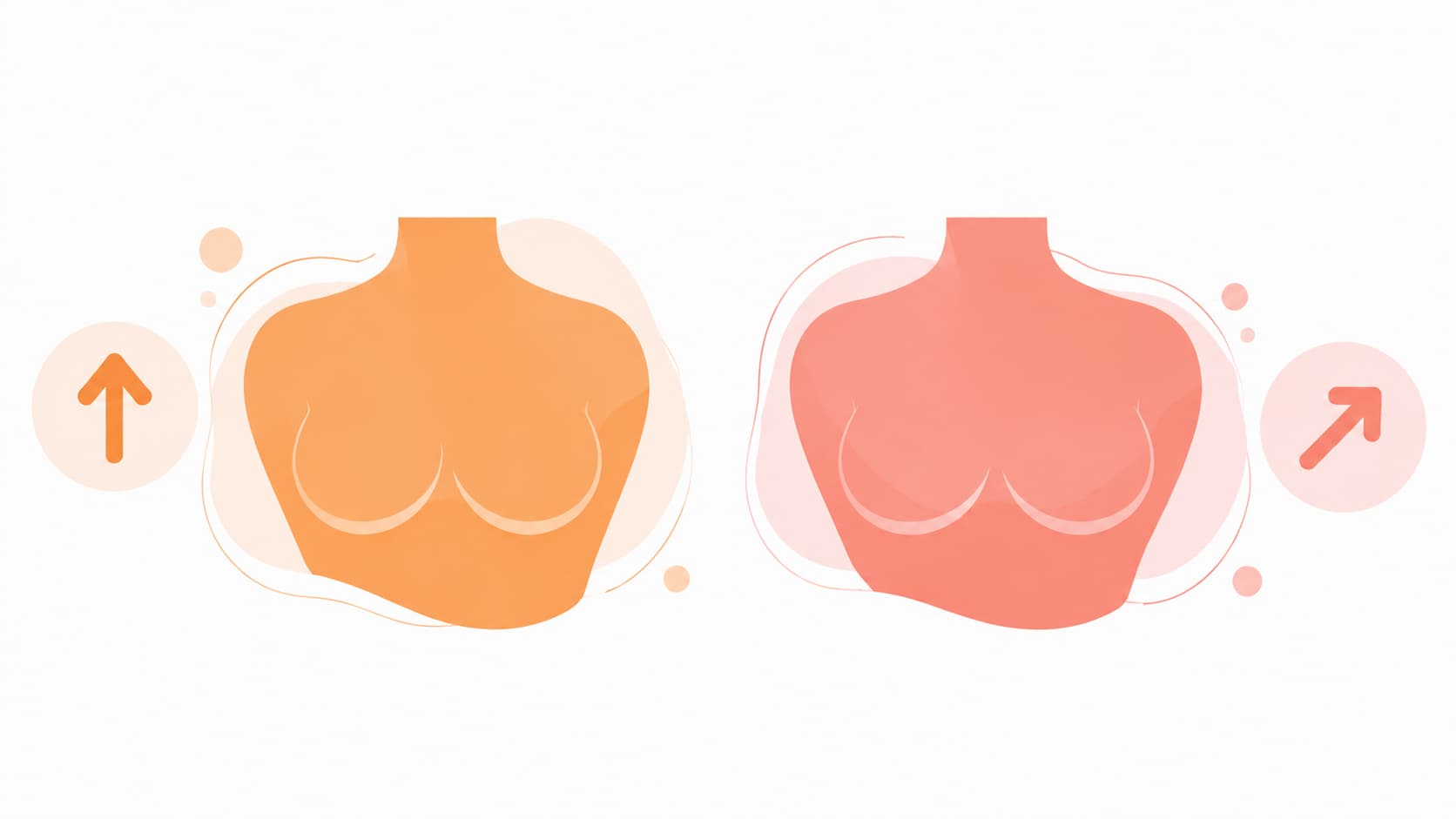
A breast augmentation adds volume using implants. A breast lift, medically known as mastopexy, repositions and reshapes the breast tissue you already have, without adding size. They solve different problems, and choosing the wrong one will not give you the result you are picturing.
Breast augmentation: what it does and doesn’t fix
Breast augmentation is a surgical procedure that increases breast volume using saline or silicone implants placed under the breast tissue or chest muscle. Patients typically choose it when they want a fuller bust, more projection, or improved symmetry, not necessarily a change in position.
Implant choice matters more than most patients expect going in. Silicone implants are prefilled with cohesive gel and tend to feel closer to natural breast tissue, which makes them a frequent choice for women with limited existing breast tissue. Saline implants are filled during surgery, which allows for more precise volume adjustment and a smaller incision.
According to the American Society of Plastic Surgeons, both implant types are FDA-approved and typically last ten to fifteen years before replacement is considered. This means the implant decision is not just cosmetic, it also sets the maintenance timeline for the years ahead.
What augmentation does not do is correct sagging. If your breasts have dropped in position, an implant alone will often make that drop more noticeable rather than less, since it adds weight and volume to tissue that is already stretched.
Breast lift (mastopexy): what it does and doesn’t fix
A breast lift, or mastopexy, raises and reshapes breasts that have lost their position on the chest, without changing how much breast volume you have. The surgeon removes excess skin, tightens the surrounding tissue, and repositions the nipple and areola higher on the chest wall.
This procedure exists because of a specific and very common change: breast ptosis, the medical term for sagging. Ptosis develops with age, pregnancy, breastfeeding, and weight fluctuation, and it happens because skin and supportive tissue stretch over time.
A lift addresses the stretching directly, and incision type is chosen based on how much correction is needed: periareolar for mild sagging, vertical for moderate cases, and an anchor-shaped incision for more significant correction. Surgeons generally consider the anchor technique the most predictable option for substantial ptosis, since it allows the most tissue repositioning.
What a lift does not do is add size. If you are already happy with your volume and only want your breasts higher and firmer, a lift alone is often the more conservative and appropriate procedure, since it avoids the maintenance considerations that come with implants.
Read more:
👉 Why do breasts sag after weight loss and what can I do?
Augmentation vs. lift: side-by-side comparison
The table below lines up both procedures on the criteria patients ask about most during a breast augmentation vs. breast lift consultation.
| Criteria | Breast augmentation | Breast lift (mastopexy) |
| Primary goal | Add volume and projection | Reposition and reshape existing tissue |
| Corrects sagging (ptosis)? | No | Yes |
| Increases cup size? | Yes | No, in most cases |
| Typical incision | Inframammary, periareolar, or trans-axillary | Periareolar, vertical, or anchor-shaped |
| Recovery before returning to light activity | About 1–2 weeks | About 2 weeks |
| Long-term maintenance | Implants often replaced after 10–15 years | Stable with healthy weight maintenance |
| Best suited for | Smaller cup size or volume loss without significant sagging | Nipple pointing downward, stretched skin, satisfied with current size |
| Compatible with future breastfeeding plans | Discuss placement with your surgeon | Generally preserves more breast tissue function |
How to know which procedure you need
Use this quick self-check before your consultation. It is a starting point, not a diagnosis.
- Check where your nipple sits relative to the breast fold: If it falls at or below the fold, this usually signals ptosis that implants alone won’t correct.
- Assess whether the change is volume or position: If your breasts feel empty but still sit high on the chest, augmentation alone may be enough.
- Look at your areola size and shape: Enlarged or stretched areolas point toward a lift, since augmentation does not reduce areola size.
- Consider your skin elasticity: Significant loose skin around the breast usually needs surgical tightening, which only a lift provides.
- Think about your goals in five years, not five months: Implants carry a replacement timeline; a lift’s results depend more on weight stability and skin quality over time.
A note on this checklist: This self-assessment is intended for adult women exploring their options and is not a substitute for a physical exam. Only a board-certified plastic surgeon can confirm candidacy after evaluating your anatomy, skin quality, and medical history in person.
Read more:
👉 Breast Augmentation Profile Guide: High, Moderate or Low
Combining both: augmentation with a lift
Many patients need both procedures, not one or the other. When augmentation and a lift are performed together, often called augmentation-mastopexy, the implant restores volume while the lift repositions the nipple and tightens skin in the same surgical plan.
Depending on the degree of sagging and the surgeon’s assessment, this can be done in a single operation or staged across two procedures. The right approach depends on tissue quality, implant size, and how much correction the skin can safely tolerate at once, which is why this decision is made individually rather than by a fixed rule.
Recovery, risks, and what to expect
Both procedures involve a real recovery period, and rushing it increases risk.
With augmentation, initial swelling usually settles within one to two weeks, though final results can take four to six months as the implants fully settle.
With a lift, results are visible almost immediately after swelling reduces, typically within about two weeks, according to the American Society of Plastic Surgeons. Both procedures generally require avoiding strenuous exercise for around six weeks.
Risks differ by procedure. Augmentation carries a higher long-term likelihood of implant-related complications such as capsular contracture or the eventual need for replacement, per guidance from the FDA. A lift carries a higher likelihood of visible scarring, since more skin is removed and repositioned. Neither risk profile is inherently worse, they are simply different trade-offs tied to what each surgery is designed to do.
Why patients choose Smart Plastic Surgery Miami
Miami’s plastic surgery market is competitive, and most clinics list similar procedures. Where Smart Plastic Surgery Miami stands apart is in how care is delivered to the city it serves.
Miami-Dade County’s population is majority Hispanic or Latino, and our team provides consultations and surgical care in English, Spanish, and Portuguese, so patients can discuss implant type, incision placement, and recovery expectations in the language they are most comfortable in, without relying on a translator during a decision this personal.
Our team includes board-certified plastic surgeons — Dr. Jeffrey Weinzweig, Dr. John Pitman III, and Dr. Richard T. Vagley are certified by the American Board of Plastic Surgery, each having completed years of accredited training and testing beyond general medical licensure. That distinction matters directly for this decision: augmentation and lift procedures both carry implant- and incision-related risks, and board certification is the credential that confirms a surgeon has been formally evaluated on managing exactly those risks.
We also work with financing partners, including Affirm and Alphaeon, so cost does not have to be the deciding factor between the procedure you need and the one you can schedule now.
Frequently asked questions about breast augmentation vs. breast lift
Many women retain the ability to breastfeed after a lift, since the procedure focuses on skin and tissue repositioning rather than removing glandular tissue. Individual outcomes depend on incision technique and should be discussed directly with your surgeon.
Most implants last ten to fifteen years before replacement is recommended, though this varies by implant type and individual factors.
Both are typically considered cosmetic and are not covered by insurance, though financing options are available to spread the cost over time.
Often yes, though your surgeon will confirm whether a single-stage or staged approach is safer based on your skin quality and the amount of correction needed.
Scheduling a consultation with a board-certified plastic surgeon is the most direct way to get an answer specific to your anatomy and goals.