
Have you ever wondered why two surgeons offering the exact same procedure can have completely different training backgrounds? You’re not the only one feeling confused.
The terms get used interchangeably in ads, social media, and even some clinic websites, but understanding plastic surgeon vs. cosmetic surgeon is one of the most important things you can do before booking any procedure. The titles sound nearly identical. The credentials behind them often aren’t. And that gap can directly affect your safety, your results, and your recovery.
This guide breaks down what each title actually means, why board certification carries real weight, and how to verify your surgeon’s qualifications before you commit.
What is a plastic surgeon?
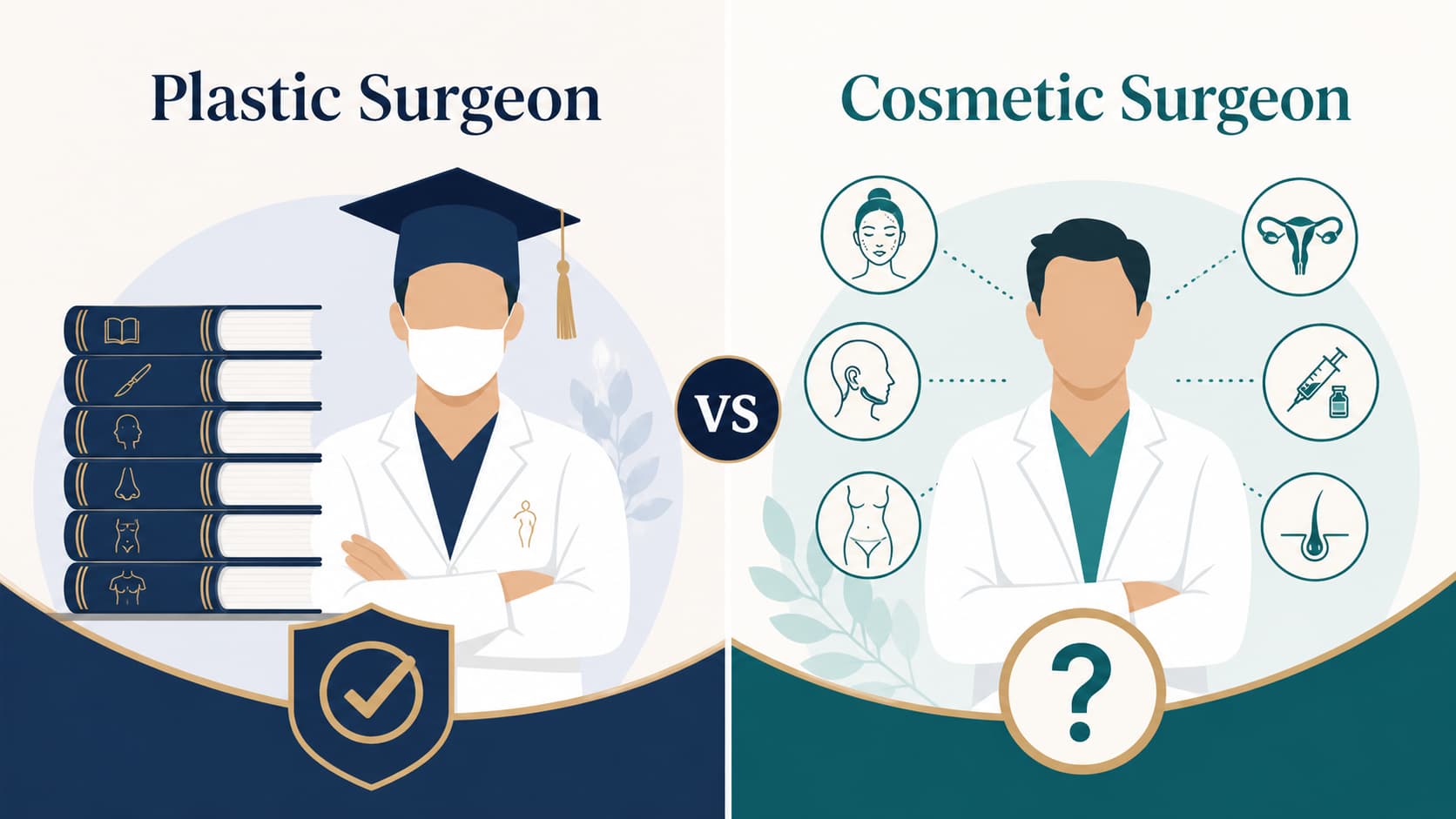
A plastic surgeon is a medical doctor who has completed at least six years of accredited surgical residency training, with a dedicated focus on both reconstructive and aesthetic surgery of the entire body. After medical school, plastic surgeons typically complete a 6-year integrated plastic surgery residency or a 3-year general surgery residency followed by a 3-year plastic surgery fellowship.
To be considered a board-certified plastic surgeon, the physician must pass rigorous written and oral examinations administered by the American Board of Plastic Surgery (ABPS), which is a member of the American Board of Medical Specialties (ABMS). According to the American Society of Plastic Surgeons, ABPS is the only board recognized by ABMS to certify physicians in plastic surgery of the face and entire body.
What a plastic surgeon is: a fully trained surgeon qualified to perform reconstructive procedures (after cancer, trauma, or congenital conditions) as well as aesthetic procedures (such as tummy tucks, breast augmentations, and rhinoplasty).
What a plastic surgeon is not: a title someone can adopt simply by performing cosmetic procedures without specialized residency training.
What is a cosmetic surgeon?
A cosmetic surgeon is a physician who performs aesthetic procedures, but the title itself does not require completion of a plastic surgery residency. Many cosmetic surgeons hold certification from the American Board of Cosmetic Surgery (ABCS), which is not recognized by the American Board of Medical Specialties (ABMS).
This means a cosmetic surgeon’s original training may come from a wide range of medical specialties, including dermatology, gynecology, otolaryngology, family medicine, or general practice. Some cosmetic surgeons complete short post-graduate fellowships (often around one year) focused specifically on aesthetic procedures, while plastic surgeons train for six or more years across the full surgical spectrum.
⚠️ Important: This doesn’t mean every cosmetic surgeon is unqualified. Some are skilled practitioners who have invested heavily in continuing education. However, because the title isn’t tied to a single standardized training pathway, the burden falls on you, the patient, to verify each surgeon’s credentials individually before any procedure, especially invasive ones performed under anesthesia.
The difference between plastic and cosmetic surgeon titles becomes most relevant when complications happen, since training in managing surgical emergencies varies significantly between the two paths.
Plastic surgeon vs. cosmetic surgeon: side-by-side comparison
When weighing cosmetic surgery vs plastic surgery providers, the differences become much easier to see in a direct comparison:
| Criterion | Plastic surgeon | Cosmetic surgeon |
| Required residency | 6+ years in plastic surgery | Varies (any medical specialty) |
| Recognized board | ABPS (ABMS-recognized) | ABCS (not ABMS-recognized) |
| Scope of practice | Reconstructive + aesthetic | Primarily aesthetic |
| Hospital privileges | Typically required | Not always required |
| Training in surgical complications | Extensive | Variable |
| Anesthesia training | Standardized through residency | Depends on original specialty |
These distinctions don’t appear on glossy before-and-after photos or marketing pages. They show up in operating rooms when something unexpected happens, and that’s exactly when training depth matters most.
Why board certification matters for your safety
Board certification by the ABPS is the single strongest indicator of a surgeon’s training depth and ongoing accountability. ABPS-certified surgeons must pass both written and oral examinations, maintain continuing education, and submit to peer review throughout their careers, a process the ABMS describes as the gold standard for medical specialty certification.
According to the American Society of Plastic Surgeons, procedures performed by board-certified plastic surgeons in accredited facilities show significantly lower complication rates than those performed in non-accredited settings by physicians without specialized training.
Here’s why board certification plastic surgery credentials should weigh heavily in your decision:
- Verify training depth: Six years of supervised surgical residency builds the muscle memory and judgment needed for complex anatomy and unexpected complications.
- Confirm hospital privileges: Hospitals only grant operating privileges to surgeons whose credentials they have independently vetted, adding a second layer of accountability.
- Check accredited facilities: Accreditation by AAAASF or The Joint Commission ensures your procedure happens in a setting with proper emergency equipment, sterilization standards, and trained staff.
- Review malpractice history: State medical board records reveal patterns that marketing materials never will.
Board certification doesn’t guarantee a perfect outcome, but it dramatically reduces the structural risks that come with insufficient training.
Learn more:
👉 What Does ‘Board Certified’ Really Mean in Plastic Surgery?
How to verify your surgeon’s credentials
Confirming your surgeon’s plastic surgeon credentials takes about ten minutes and can save you years of regret. Use this checklist before any consultation:
- ✅ Search the surgeon’s name on certificationmatters.org — the official ABMS database confirms whether the physician is truly board-certified in plastic surgery.
- ✅ Confirm hospital privileges in your area — call the hospital directly or check their physician directory.
- ✅ Verify facility accreditation — the surgical center should be accredited by AAAASF, AAAHC, or The Joint Commission.
- ✅ Review verified before-and-after galleries from real patients with similar body types and goals.
- ✅ Read reviews across multiple platforms — RealSelf, Google, and the surgeon’s official ASPS profile each capture different patient experiences.
- ✅ Schedule a consultation and ask directly: “What is your complication rate? How do you handle revisions? Where do you have hospital privileges?”
A surgeon who hesitates to answer any of these questions transparently is telling you something important.
What sets Smart Plastic Surgery apart in Miami
Choosing a plastic surgeon Miami patients can trust means looking past the marketing and into the credentials, the team, and the standards of care. Here’s how Smart Plastic Surgery measures up against those criteria:
- Truly bilingual care for Miami’s diverse community. Miami-Dade County’s population is approximately 68.7% Hispanic or Latino, and our team delivers consultations, pre-op education, and post-op follow-up in English and Spanish. Understanding your surgeon, and being understood, isn’t a luxury when you’re making decisions about your body.
- Full surgical scope. Because our surgeons trained in both reconstructive and aesthetic plastic surgery, we approach every body contouring, breast, and facial procedure with the technical depth that complex anatomy frequently requires.
- Accredited surgical environment. Procedures take place in facilities that meet recognized accreditation standards, with the emergency protocols and trained staff that board-certified surgery demands.
When you compare a bilingual plastic surgeon Miami options head-to-head against the criteria that actually predict surgical outcomes, the differences between a cosmetic surgeon practice and Smart Plastic Surgery become very tangible.
Frequently asked questions about plastic surgeon vs. cosmetic surgeon
Pricing varies more by geographic location, surgeon experience, and facility fees than by title alone. A board-certified plastic surgeon’s quote often reflects accredited facilities, certified anesthesia, and built-in revision policies, costs that frequently appear later as add-ons in lower initial quotes.
fter a 4-year medical degree, a plastic surgeon completes either a 6-year integrated plastic surgery residency or a 3-year general surgery residency plus a 3-year plastic surgery fellowship — followed by ABPS board examinations. Total training typically spans 13 to 14 years post-college.
Ask about board certification (specifically ABPS), facility accreditation, complication rates, revision policies, and where the surgeon holds hospital privileges. Any board-certified surgeon will answer these openly.
Reconstructive procedures (after mastectomy, trauma, or congenital conditions) are frequently covered when medically necessary. Purely aesthetic procedures generally aren’t. Your surgeon’s office can help you determine which category your procedure falls into.