
If your bras fit differently, your cleavage looks flatter or the top of your breasts seems empty, you are noticing a change most women experience at some point. Breasts respond to age, pregnancy, weight and hormones, and knowing which of these is behind your change makes it much easier to choose the right next step.
Breasts lose volume when the glandular tissue and fat inside them shrink while the skin and ligaments around them stay stretched. The result is a flatter, emptier breast, especially in the upper half. Breast volume loss is not a disease, and it is not the same as sagging (breast ptosis), although the two often happen together.
This guide explains why it happens, which beliefs are myths, and how our surgeons at Smart Plastic Surgery help patients restore fullness safely.
What does it mean when breasts lose volume?
A breast loses volume when what fills it shrinks faster than the skin that holds it. Each breast is made of glandular tissue (milk ducts and lobules), fat, connective bands called Cooper’s ligaments, and skin. Volume comes from the gland and the fat; shape and position depend on the ligaments and the skin.
The American Society of Plastic Surgeons (ASPS) explains that breasts contain a substantial amount of fatty tissue, and the skin envelope does not necessarily shrink at the same rate when that tissue decreases. That mismatch is what people describe as deflated breasts: the envelope is now larger than what it contains.
Upper pole fullness is the volume in the part of the breast above the nipple. It is usually the first area to look hollow, and it is not something a lift alone restores. That detail matters later, when you compare procedures.
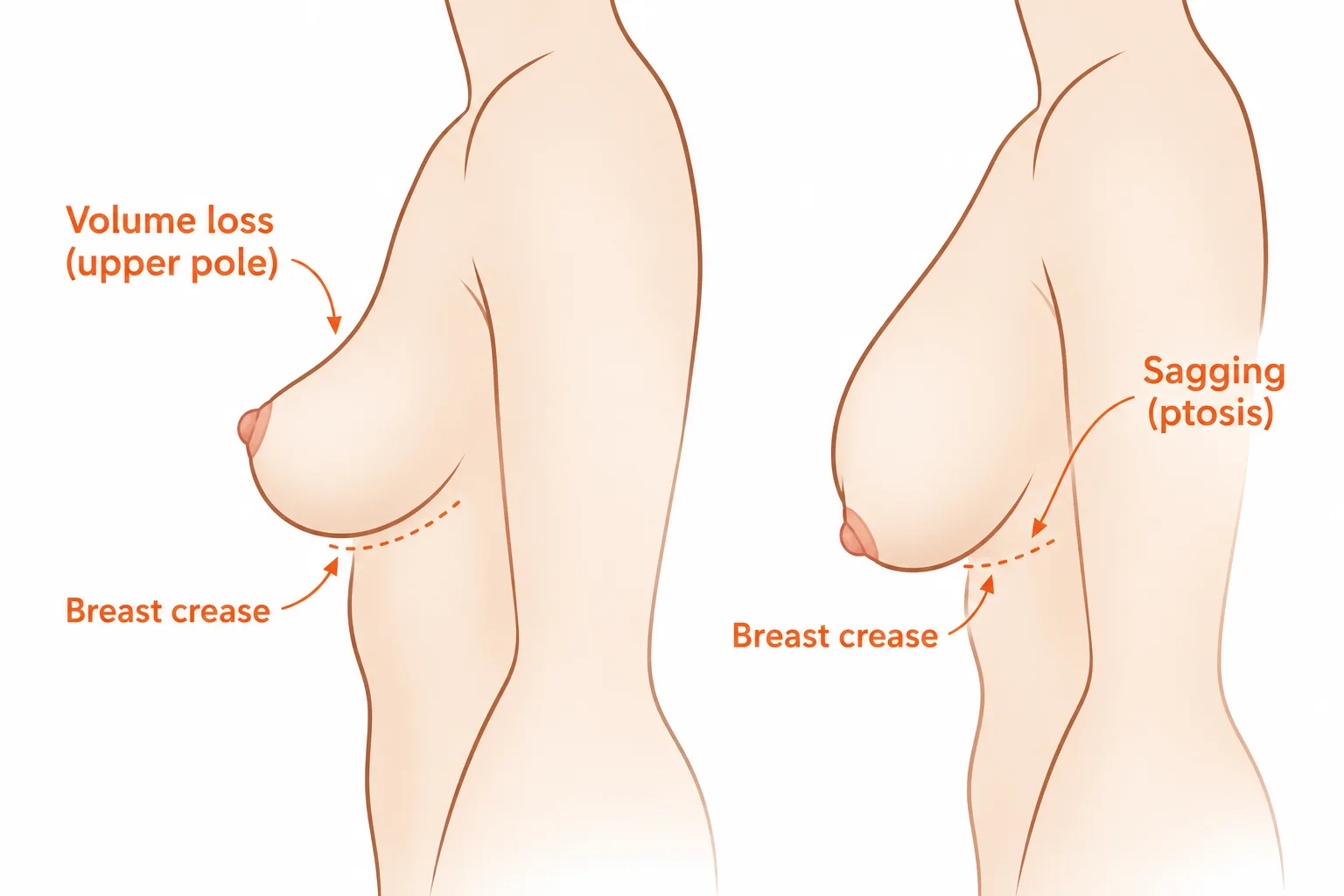
Volume loss and sagging look similar in the mirror, but they are different problems with different solutions:
| Criteria | Deflated breasts (volume loss) | Sagging breasts (ptosis) |
| Main change | Less tissue inside the breast | Breast and nipple sit lower on the chest |
| Where you notice it | Upper half looks flat or hollow | Lower half hangs at or below the breast crease |
| In your bra | A gap at the top of the cup | Tissue settles at the bottom of the cup or below the band |
| Nipple position | Often unchanged | At or below the breast crease, sometimes pointing down |
| Typical surgical answer | Add volume with implants or fat | Lift and reshape with a mastopexy |
Many women have both at once, which is why a breast lift with implants is one of the most common plans after pregnancy or major weight loss.
Why do breasts lose volume? The most common causes
Breast volume loss usually comes from several factors working together. These are the causes our surgeons see most often in consultation.
1. Aging, estrogen and menopause
Aging is the most common reason breasts lose fullness. As estrogen declines, especially around menopause, glandular tissue gradually shrinks and is replaced by fat, a process called involution, while the skin produces less collagen and elastin. WebMD notes that menopause can affect the fullness of the breasts and reduce their volume.
The age pattern shows up in surgical data too: 43% of all breast lifts performed by ASPS member surgeons in 2024 were in patients aged 40 to 54. If your breasts started changing in your 40s, you are following a very common timeline.
2. Pregnancy and the number of pregnancies
Pregnancy changes breasts more than almost anything else, and the effect builds with each pregnancy. During pregnancy, glandular tissue grows to prepare for milk production; afterward it shrinks back, often below its original size, while the stretched skin stays looser.
In a study presented at the ASPS annual meeting and later published in the Aesthetic Surgery Journal, 55% of women reported a negative change in breast shape after pregnancy, and the number of pregnancies was a significant risk factor for sagging. If you plan to have more children, it usually makes sense to wait before any breast surgery.
3. Weight loss and weight fluctuations
Because breasts are partly fat, losing weight almost always takes some breast volume with it. How much depends on your breast composition: one tissue study found that fat made up anywhere from 7% to 56% of total breast volume.
Repeated cycles of gain and loss stretch the skin again and again, so it retracts less each time. If weight loss is the main reason your breasts changed, our guide on why breasts sag after weight loss covers that situation in detail.
4. Genetics and breast composition
Your genes set the baseline for how your breasts age. They influence how much of your breast is gland versus fat, how elastic your skin is, and how strong your connective tissue is.
This is why two women with the same age and weight change can end up with very different results. If the women in your family noticed early changes, you may see them earlier as well, regardless of lifestyle.
5. Smoking and sun exposure
Smoking speeds up breast changes by damaging the skin’s support fibers. The same ASPS-presented study identified smoking history as a significant risk factor for breast sagging, and its lead author explained that smoking breaks down elastin, the protein that keeps skin elastic.
Ultraviolet exposure also degrades collagen in the thin skin of the chest. Quitting nicotine and protecting the décolletage with sunscreen are two of the few prevention steps fully in your control.
6. High-impact exercise without proper support
Exercise does not shrink glandular tissue, but unsupported movement may strain the ligaments over time. Running and jumping move the breasts in several directions, and a well-fitted sports bra reduces that movement.
The evidence on bras and long-term sagging is limited, so think of a sports bra as comfort and protection, not as a way to stop volume loss.
Does breastfeeding make breasts lose volume?
Breastfeeding itself does not appear to cause breasts to lose shape. Pregnancy does. This is one of the most persistent myths our surgeons hear.
In the study of women seeking breast lifts or augmentation, researchers found that a history of breastfeeding, the number of children breastfed, how long each child was breastfed and the weight gained during pregnancy were not significant predictors of losing breast shape.
The factors that did matter were body mass index, the number of pregnancies, a larger pre-pregnancy bra size, smoking and age.
| Myth | What the evidence says |
| Breastfeeding “drains” the breasts | Breast changes come mainly from pregnancy, with or without nursing |
| Nursing longer causes more volume loss | Duration of breastfeeding was not a significant predictor |
| Bottle-feeding protects breast shape | Women who did not breastfeed showed similar degrees of sagging |
If you want to breastfeed, you can make that choice without worrying that it alone will change your breasts. When you are done having children, a mommy makeover can address breast and abdominal changes in one plan.
Ozempic breasts: how GLP-1 weight loss affects breast volume
“Ozempic breasts” is a popular term, not a diagnosis, for breasts that deflate after fast weight loss on GLP-1 medications such as semaglutide (Ozempic, Wegovy) or tirzepatide (Zepbound).
The ASPS describes what surgeons see in these patients as loss of breast volume, deflation of the upper pole, increased skin laxity and varying degrees of ptosis, the same pattern long seen after major weight loss. Demand is growing quickly: in 2025, 87% of ASPS member surgeons reported GLP-1-related consultations for breast surgery. For many of these patients, the ASPS notes that augmentation needs to be combined with a lift to restore shape.
The best time to plan surgery is once your weight has been stable for several months, so the result is not deflated by further loss. Our article on breast lift after weight loss explains timing and techniques step by step.
Read more:
👉 Why do breasts sag after weight loss and what can I do?
Signs your breasts have lost volume
Use this quick self-check in front of a mirror, standing and without a bra:
- A gap at the top of your bra cups that was not there before
- The upper half of the breast looks flat or slightly hollow
- Breasts feel softer and less firm to the touch
- Cleavage is less defined without a push-up bra
- Thinner, looser skin on the upper chest
- Nipples sit lower or point downward
- One breast has changed more than the other
Breast ptosis is the medical term for sagging, and surgeons grade it by where the nipple sits in relation to the crease under the breast. As WebMD summarizes, the lower the nipple sits compared with that fold, the higher the grade:
| Grade | Nipple position | What it often means for treatment |
| No ptosis | Above the breast crease | Volume can often be restored with augmentation alone |
| Grade 1 (mild) | Level with the breast crease | Implants may be enough; some patients benefit from a small lift |
| Grade 2 (moderate) | Below the breast crease | A lift is usually needed, with or without implants |
| Grade 3 (advanced) | Below the crease and pointing downward | A full lift, often combined with implants |
Attention: this self-check is for adults evaluating aesthetic changes. It does not replace a medical exam. See your doctor promptly if you notice a new lump, a change that appears suddenly in only one breast, nipple discharge, a nipple that newly turns inward, or skin dimpling, redness or thickening. Cosmetic breast surgery is not recommended during pregnancy or breastfeeding, and your surgeon may ask for an up-to-date mammogram before surgery, depending on your age and history.
Can men lose chest volume too?
Yes. Men who lose a lot of weight often end up with a softer, looser chest instead of a flatter one. When fat leaves the chest, stretched skin can remain, and some men also have glandular tissue that never responded to diet. Cleveland Clinic explains that enlarged male breasts caused by excess fat may improve with weight loss, while true gynecomastia (glandular tissue) does not.
Male chest surgery is common: ASPS member surgeons performed 26,430 gynecomastia procedures in 2024. A male breast reduction can remove gland, fat and excess skin to restore a firmer chest contour.
Can you restore breast volume without surgery?
Non-surgical options can change how your breasts look, but none of them replaces lost breast tissue. Here is what each one realistically does:
- Chest exercises: push-ups and presses build the pectoral muscle behind the breast. This may improve the contour of the chest wall, but it does not add breast tissue.
- Weight gain: may return some fat to the breasts, but you cannot choose where your body stores it.
- Creams, pills and supplements: there is no reliable evidence that any of them restores breast volume.
- Push-up or padded bras: change how you look in clothes while you wear them, nothing more.
- Skin-tightening devices: may improve skin texture on the chest, but they do not refill an empty breast.
If you want your volume back, the predictable options are implants or fat transfer, and a lift when position is part of the problem. That is not a reason to rush into surgery; it is a reason to spend your time and money on options that can deliver what you want.
Breast lift vs breast augmentation: which restores lost volume?
Augmentation restores volume, a lift restores position, and many women need both. The ASPS states that breast augmentation does not correct severely drooping breasts, and that a breast lift does not significantly change breast size or round out the upper part of the breast. Both procedures are among the most performed in the country: ASPS members performed 306,196 breast augmentations in 2024, and breast lifts rose 8% in 2025 to 156,131 procedures. Matching the procedure to your actual problem is what produces a natural result.
This table compares the main options using the same criteria:
| Procedure | Adds volume? | Corrects sagging? | Best for | Main trade-off |
| Breast augmentation (silicone or saline implants) | Yes | No | Volume loss with the nipple above the crease and good skin quality | Implant monitoring and possible future replacement |
| Breast lift (mastopexy) | No, it reshapes existing tissue | Yes | Sagging with enough natural volume | Lift scars; limited upper fullness |
| Breast lift with implants (augmentation mastopexy) | Yes | Yes | Volume loss plus grade 2 or 3 ptosis, common after pregnancy or major weight loss | Lift scars plus implant maintenance |
| Fat transfer breast augmentation | Yes, modest | No | A small volume gain, enough donor fat, preference for no implants | Limited size increase; part of the transferred fat may not survive |
| Mommy makeover | Depends on the combination | Depends on the combination | Breast changes plus abdominal changes after children | Longer combined recovery |
Read more:
👉 Breast augmentation vs. breast lift: which one do you need?
How to choose the right procedure for your breasts
These steps help you arrive at your consultation with the right questions:
- Name your main concern. Why it matters: an empty upper breast and a low nipple need different solutions.
- Check where your nipple sits compared with your breast crease. Why it matters: a nipple below the crease usually means a lift is part of the plan.
- Reach a stable weight. Why it matters: further weight loss can deflate your result, especially after GLP-1 treatment.
- Plan around pregnancy and breastfeeding. Why it matters: research shows breast changes increase with each pregnancy.
- Stop smoking and nicotine. Why it matters: nicotine reduces blood flow to the skin and affects healing.
- Choose a board-certified plastic surgeon and review real results. Why it matters: training and experience shape both safety and how natural your breasts look. You can start with our results gallery.
Our pre-operative guide shows how our team helps you prepare once you decide.
Restoring breast volume at Smart Plastic Surgery
Smart Plastic Surgery builds one plan around both volume and position, so your result looks full and lifted rather than just bigger. Every consultation starts with an assessment of your skin quality, remaining volume and nipple position, the same factors that decide whether you need implants, a lift or both. Here is what that looks like in practice:
- An experienced surgical team: several of our surgeons hold FACS fellowship. Dr. Richard T. Vagley brings more than four decades in aesthetic surgery, Dr. Jeffrey Weinzweig is an internationally recognized surgeon, educator and author, and Dr. John Pitman III grades breast changes at consultation to match each patient with the right technique.
- Every option under one roof: breast augmentation, breast lift, lift with implants and fat transfer, which can be combined with a tummy tuck or a mommy makeover when your health allows.
- Care in English, Spanish and Portuguese: from the first consultation to your last follow-up. ¿Notas que tus senos perdieron volumen? Nuestro equipo te atiende en español.
- Flexible financing: Affirm, Alphaeon and CareCredit, with payment plans starting at $30 per week.
- Support for traveling patients: our out-of-town program helps you plan your stay and recovery.
If you are considering breast augmentation or a breast lift in Miami to restore lost volume, schedule your consultation or call (305) 306-7282. You will leave with a plan built for your body and honest answers about what each option can achieve.
Ready for the next step?
Let’s plan a result that fits your body and your goals
Meet with our team for a free consultation, ask every question you have, and leave with a personalized plan.
- Free consultation
- Flexible financing
- English, Español, Português
Frequently asked questions
Some volume often returns in the months after you stop nursing, as hormones settle. Tissue lost to involution and stretched skin usually do not recover fully, so many women notice a lasting change after pregnancy.
There is no fixed age. Many women notice changes after pregnancy or in their 40s, as estrogen begins to decline, and changes often become more visible around menopause.
Hormonal changes, such as perimenopause or stopping hormonal birth control, can reduce glandular tissue without any change on the scale. A sudden change in only one breast should be checked by a doctor.
Implants keep their size, but your natural tissue keeps aging, and weight changes or pregnancy can alter your result. Keeping a stable weight helps preserve it for longer.
Yes, once your weight has been stable for several months and your surgical team has reviewed your medication plan. Many GLP-1 patients need a lift combined with implants rather than implants alone.
Fat transfer works best for a modest volume gain in women with good skin and enough donor fat. It does not lift the breast, so it is rarely enough on its own when sagging is moderate or advanced.